
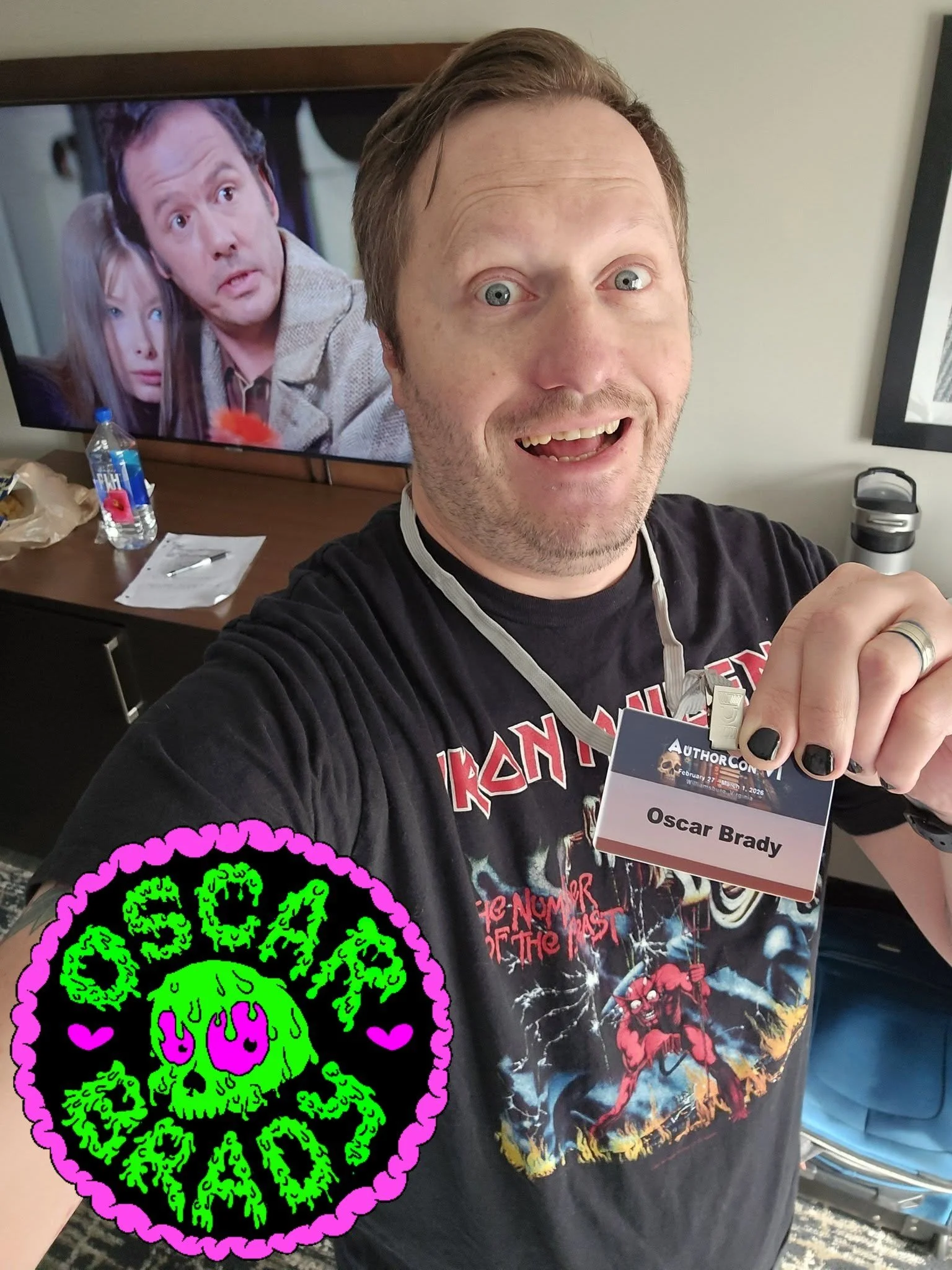
Self-Publisher Interview with Oscar Brady
1. What can you tell me about your experience as a writer?
I used to write short stories for my friends in middle and high school, then kept writing and self-published those shorts on a website I built a lonnnng time ago. Like GeoCities days. I shared the link with my friends but that was the extent of it. I’d only been able to write short stories, as I would get stuck in the mire of self-editing too early to be able to finish a longer form of fiction. That and writer’s block. Then one day, I decided as a sort of bucket list item that I wanted to be published. For short stories, I figured the best way would be with a literary journal. After dozens of rejections, I finally had a creative nonfiction piece published in a college journal, then shortly after, I had a quiet horror short story published in another journal. All of this was under a different pen name.
2. What made you decide to write a book?
I ended up taking a multiyear break from writing after my dad passed, but I kept reading and eventually discovered a subgenre that spoke to me: splatterpunk. Between it and its sister subgenre of horror, extreme horror, I was reminded of the gory movies I loved watching as a teen and older. For readers who don’t know the difference, in a nutshell, both subgenres diverge from quiet horror through graphic violence, gore, and other nasty stuff meant to unsettle the reader. With extreme horror, the whole point is to shock, while with splatterpunk, there’s a deeper sociopolitical theme. So in 2024, in what ended up being the last NaNoWriMo, I decided I would finally do it, I would write a full-length novel of 50k+ words.
3. What circumstances brought you to the decision to self-publish your book?
I wanted to get my story out there. Friends told me it was good enough to be traditionally published, but I didn’t know where to even start in finding a literary agent who would work with this sort of fiction. I wasn’t really in the community yet, so I hadn’t built any sort of network. Plus, I wanted to get my book out there and be published; I wasn’t out for fame or glory or whatever.
4. What has your experience as a self-publisher been like?
Time consuming! I taught myself how to use the Procreate app, which is a drawing program, to make my cover. Along with having my wife beta read, I self-edited dozens of times, and still there were mistakes. (Lesson learned: Hire an editor!) I also went through a bunch of tutorials and such to figure out how to self-publish through KDP. Fortunately, the Kindle Create app helps with formatting because I sucked at it then. Now, I can do everything. I do all of my formatting in Word, using online tutorials for print publishing. I use Calibre to publish EPUBs, editing using the CSS scripting I self-taught back in my GeoCities days. I’ve built a network of other authors, editors, publishers, and cover artists who’ve become my friends.
5. How do you respond to the negative stigma attached to self-publishing and self-published books?
People assume that just because someone self-publishes, that means they aren’t good enough to be traditionally published. Consider the Dungeon Crawler Carl series. The first SEVEN books were originally indie published before it was picked up by a Penguin Random House imprint. Some people, like me, self-publish because they just want to get their story out there without dealing with the bureaucracy of major publishing. Plus, most traditionally published books don’t sell more than a few hundred copies, if that. There’s this idea that anybody can self-publish, when in reality, it takes way more work than to go through a press. Self-publishing authors have to do ALL of the work outside of the writing… things that the publisher does for the author, we have to do it ourselves.
6. What is one very important lesson you have learned as a self-publisher so far?
What we have over the traditional published: no deadlines! So don’t create deadlines for yourself and stress yourself out for no reason. Just go with the flow!
7. What do you know now about self-publishing that you wish you knew at the beginning?
Do not waste money on physical ARCs for unknown readers/reviewers, ebooks are fine.
8. A lot of authors of self-published books have reservations about promoting and marketing their book. Some even feel that it is a form of vanity or self-importance. What is your opinion about this?
First of all, if you don’t promote yourself, you can’t expect others to do it for you. It’s a balance. Don’t just promote yourself, but other authors, too. Also, push marketing very rarely works to get new readers. Instead, just talk about your process or other things you’re into, then every once in a while, “Oh yeah, I got this book coming out.”
9. How do you promote your books and what form of book promotion has worked the best for you?
I’ll do the usual cover reveals and quotes from reader reviews, but I’ve also gotten more creative using Tiktok or Instagram to make videos with stock clips that have the book’s vibe. What works best is sending to ARC readers, especially if you can get book influencers to read and review.
10. What are some other important things you have learned as a self-publisher?
Kindle Unlimited is good for reach, but not money. I think that’s widely understood, but still.
11. Do you feel that self-publishing is a viable choice for other authors?
Sure, it’s all about what your priorities are. If you just want to get your book out there and you don’t care how many people read it, then self-publishing is the best option. There’s still a good chance you’ll get a lot of readers, but it will be more work. It’s a LOT of work in general, but there are people out there who can help if you have questions, plus plenty of videos and guides out there to help. It is also kind of a learn-as-you-go process.
12. How do you feel that self-publishing their books has helped many unknown authors finally get the recognition their books deserve?
It puts the power in the author’s hand. Those major publishers think they know what people want to read, but sometimes even the big five books will only sell like a dozen copies. They drop authors from their roster not because their stories aren’t good, but because they don’t fit the demographic they think will sell books. Those publishers only care about what they think is marketable, not what makes a good story. Every story deserves to be told, and there’s a perfect reader out there for everyone. Just remember what you’re doing it for – the art, the craft, reaching someone you’ve never met with your poetry or prose. If you’re in it for money and glory, you will be very disappointed.
ABOUT OSCAR:
Oscar Brady (he/they) is a splatterpunk author from Virginia who writes weird stories for weird people, whose nasty prose won the 2026 Scares that Care presents AuthorCon’s Gross-Out Competition. Oscar also creates custom hand-drawn covers for fellow indie authors at affordable prices in an effort to remove the temptation of authors using generative AI. Oscar’s next novel is Ronin, a sapphic dystopian sci-fi horror novel taking place in the near future, starring a machete wielding Afropunk mercenary; coming in August. As his other penname, Jimmy Sploots, he is the illustrator of the upcoming children’s book The Not So Scary Castle by J.W. Oliver and Austin Harris, coming July 3.