Interview with Author
John B. Rosenman
1. When did you start writing?
I’ve been writing or making up stories almost all my life. When I was really small, my father used to tell me bedtime stories, and that was one of the influences that started me scribbling. Back then, there were no TVs or computers, so I crawled under the covers at night and listened to The Shadow, Inner Sanctum, and The Fat Man on the radio. Those programs were particularly scary in the dark, and they fired my imagination. I recall drawing cartoon panels with crayons when my fingers were barely large enough to hold them. One cartoon strip – I think it was Mandrake the Magician, featured an ominous character called The Dark One, and I terrorized my family by posting warning notes in the backyard signed The Dark One. In them I warned that if they didn’t obey my commands and leave a dollar on the picnic table, that terrible things would happen to them. Well, that’s a form of writing, isn’t it? You can see that even when I was four, five, or perhaps a bit older, that my dark, creative bent was obvious.
2. What was your journey towards becoming an author like?
Rough and painful, joyful and exultant. But usually, somewhere between those two extremes. When I was forty, I wrote a tell-all novel about my teaching job that my wife warned me not to write, and sure enough, after it was published, it cost me two jobs. I’ve submitted a lot of stories and received a lot of rejections. So far, I’ve published two dozen novels and two hundred short stories, most in the science fiction, fantasy, and horror genres. For a while, I was Chairman of the Board of the Horror Writers Association, and used my contacts with writers to network and promote my fiction.
I’m a pantser and make things up as I go along, and over the years, I have relied heavily on the critiques of fellow writers. For twenty years, I belonged to a writers’ group whose criticisms enabled me to publish dozens of manuscripts. I tend to be relentless and stubborn, so as long as I have faith in a story or novel, I keep submitting it for publication. Do you know, one of my poems, a 13 liner, was rejected 49 times. Did I give up? Nope, never. I licked my wounds and persisted. On the 50th time, I struck paydirt, and for cash, too!
3. What can you tell me about your latest book? (Feel free to include an excerpt.)
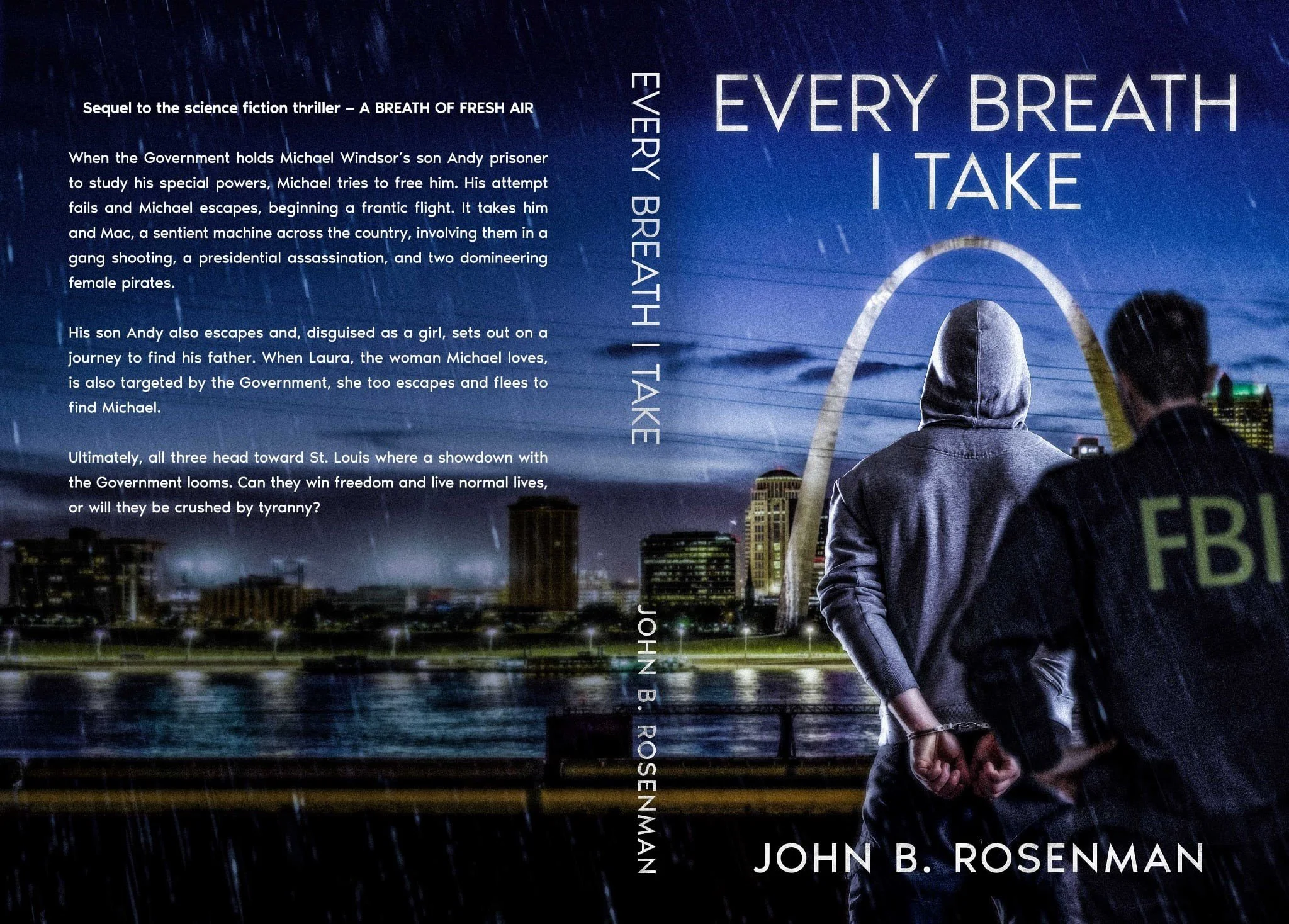
Every Breath I Take is the second book in a series. (Check out the series at this link.) The first book is A Breath of Fresh Air. They were both inspired by the fact that I have (suffer from) sleep apnea. In the first novel, I gave my protagonist my exact symptoms, which include near-death experiences struggling to breathe as I slept. Then I capitalized on the fact that on an assembly line, once in a million or a billion or a trillion times, something goes seriously wrong or wonderfully different. That’s the case with Mac, Michael’s intelligent sleep apnea machine. Man, it’s the Industrial Revolution on steroids. Much of the rest of the series is fueled by my mistrust of the government. Does it have our best interests at heart? Nah! The Government and its agents relentlessly pursue Michael Windsor and his mechanical sidekick Mac for the psychic and other powers that Mac possesses. Can they escape or will they be caught? And how can they possibly survive?
John B. Rosenman
A Tense Scene From the Novel . . .
Yes, the man seemed authentic and down-to-earth, Michael thought. He could do so much with so little, communicate a whole inward drama with a smile or a twitch of an eyelid. But wasn’t that what a good politician did? He made you believe in him.
Exactly right, Mac agreed. The President is a good politician. It’s how he got to the top of the mountain.
He’s a performer.
Maybe, but Michael was sensing an opportunity. For months, he had run from the Government, from the Feds who wanted to rape him for his gifts. What better remedy was there for him than to go to the supreme leader of that Government, the biggest fish of all, and plead for help? And to do it now before that man sat down to eat?
Michael started forward, only to feel a strong hand grip his shoulder. Turning around, he saw Nat shake his head.
“Don’t do it,” Nat said.
Michael yanked away, hearing Mac repeat Nat’s words.
Don’t do it!
But he had to try when he had the chance, the best chance he might ever have. He had to do it now before the man sat down and began to stuff his face.
Michael took a step toward the President, then another. As he did, he caught something odd out of the corner of his eye, something that didn’t fit. He stopped.
One of the customers had stepped toward the President and raised his hand. Even if the grenade-shaped item he held wasn’t a weapon, it had no business being there because the Feds or Secret Service always removed suspicious objects or potentially dangerous items from people’s pockets in situations that involved the President. Possibly, Michael was mistaken and it was nothing. The Feds just didn’t screw up.
But something in the man’s smile said otherwise.
Maybe there’s two assassins, Mac said. Not just one!
Michael spun and lunged toward the man, seeing his arm go back and come forward to throw the object directly at the President. At the last moment, Michael managed to strike the man’s wrist, deflecting the object and sending it spinning.
An instant later, it exploded, blasting people into the air and filling the terrace with smoke. Michael came down, striking the floor with his head. The last thing he remembered before he passed out was the shrill sound of screams, punctuated by gunshots.
4. What sort of methods do you use for book promotion?
Well, you’re looking at one method. I do interviews. You can find videos of some of them on my website. I also participate in book signings at festivals, writers’ conferences, and bookstores. For example, in three weeks, I will join a writer buddy of mine at Marscon, a science fiction and fantasy conference in Norfolk, VA. Most often, I post ads for my books online – Facebook, Linkedin, X, Nextdoor, and so on. I also have a blog and produce an occasional newsletter. I have to confess, though, that I’m not particularly good at book promotion. There are some methods and opportunities I don’t use much or use at all. But if you get me to talk about my writing, watch out! Once I start, I can talk your ear off.
5. Where do you get your ideas for stories?
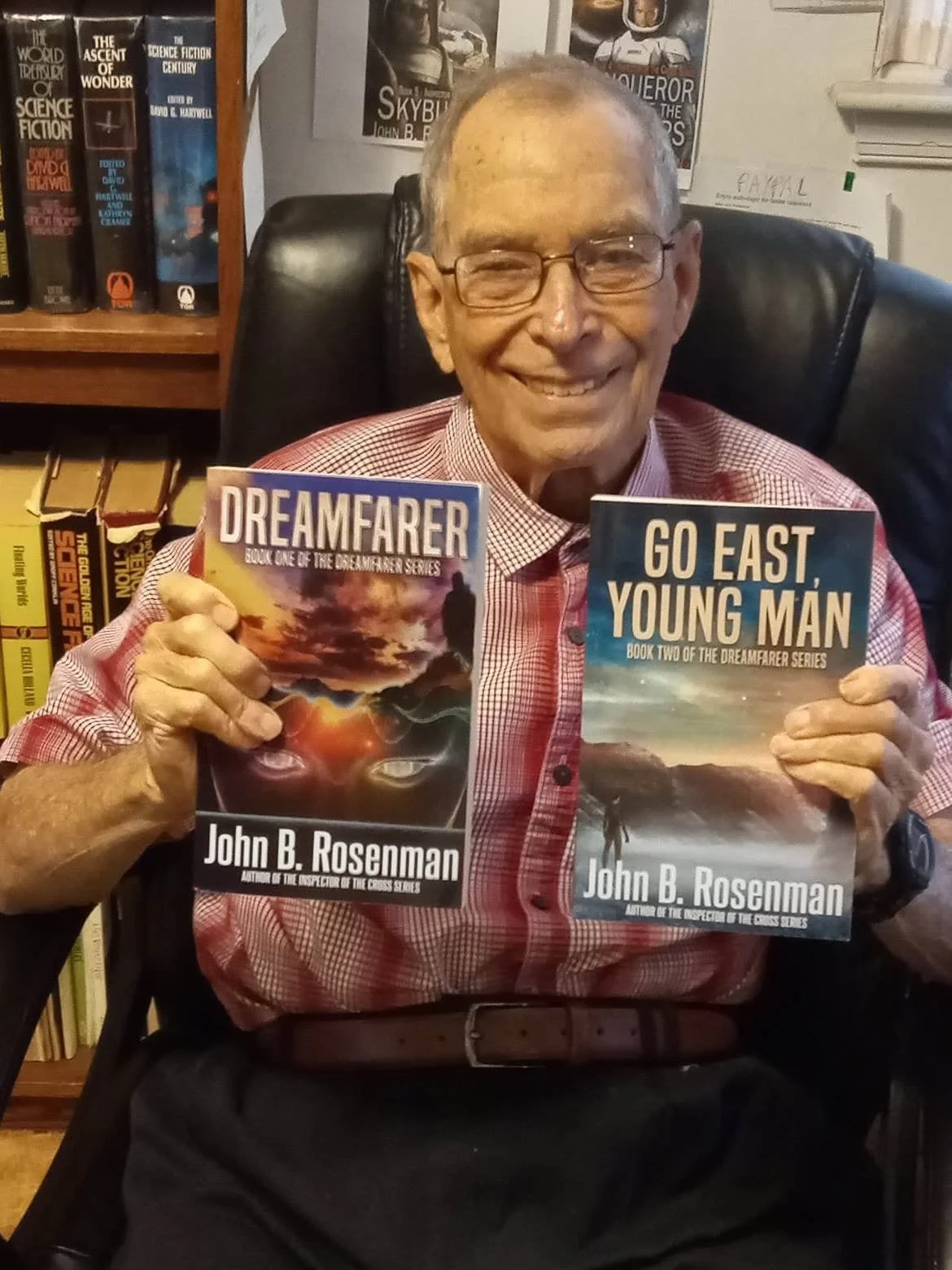
Sometimes, I get them from the tiniest of seeds or a mere wisp of an idea. For example, one day the word “dreamfarer” popped into my head. What is a dreamfarer? I wondered. Well, you have seafarer, and wayfarer and starfarer. So . . . why not a dreamfarer who travels in dreams and has exciting adventures? From that miniscule germ I concocted a dystopian, three-book, post-World War III world where people are placed into dream machines and have the dreams of their precise choice when they turn thirty-two. My current two-novel series was inspired only by the fact that I have sleep apnea. Often the source of my inspiration is as insubstantial as a shadow. Other times, it may be prompted by something more tangible, such as an editor’s invitation to an anthology. This is the case, for example, with the two stories I published in the Weird Western collection, Something Wicked This Way Rides, published by Dark Owl Publishing, LLC.
6. What are you working on right now?
Sadly, I’m not. I’m 84 years old and appear to be running out of ideas. Perhaps your readers can suggest something. Wait. Something’s coming . . . A man finds a deluxe, gaudy, gift-wrapped Idea Machine. The only problem is, it’s locked, and he doesn’t have the combination. What can he do?
7. Any advice for other authors?
Read, read, read the best as well as the worst so you can tell the difference and are also well-read. Read widely, not just in the genres or subjects you like but in areas you may even dislike or see as irrelevant.
Write, write, write, and take a few courses or workshops in creative writing. Join a good, critique-oriented writers’ group and get constructive criticism. Avoid groups whose members praise each other too much and pat their pals’ backs. Even if it hurts and bruises your sensitive ego, seek out honest and perceptive criticism and learn to critique yourself.
Finally, get out into the world a little and live! Collect experiences that will deepen your wisdom and enrich your writing.
ABOUT JOHN:
John was born in Cleveland, Ohio in 1941 and has been married to his wife Jane since 1967. They have two children, Lori and David. In 1970, John received his Ph.D. in English from Kent State University. From 1982 to 2011, he was an English professor at Norfolk State University where he designed and taught a course in how to write science fiction and fantasy. He is a former Chairman of the Board of the Horror Writers Association and has published 200 stories in places such as Weird Tales, Whitley Strieber’s Aliens, Fangoria, Galaxy, Endless Apocalypse, The Age of Wonders, and the Hot Blood erotic horror series. John has published two dozen books, including Sci-Fi action-adventure novels such as Beyond Those Distant Stars, Speaker of the Shakk, A Senseless Act of Beauty, Alien Dreams, and the Inspector of the Cross series (Crossroad Press). He also published a four-book box set, The Amazing Worlds of John B. Rosenman (MuseItUp Publishing). In addition, he has published two mainstream novels, The Best Laugh Last (McPherson & Company) and the Young Adult The Merry-Go-Round Man (Crossroad Press). Recently, he published the Dreamfarer trilogy with Mystique Press. It consists of Dreamfarer, Go East, Young Man, and Dreamchaser. A personal note: John has sleep apnea, and his health condition inspired A Breath of Fresh Air and Every Breath I Take, published by Mystique Press.